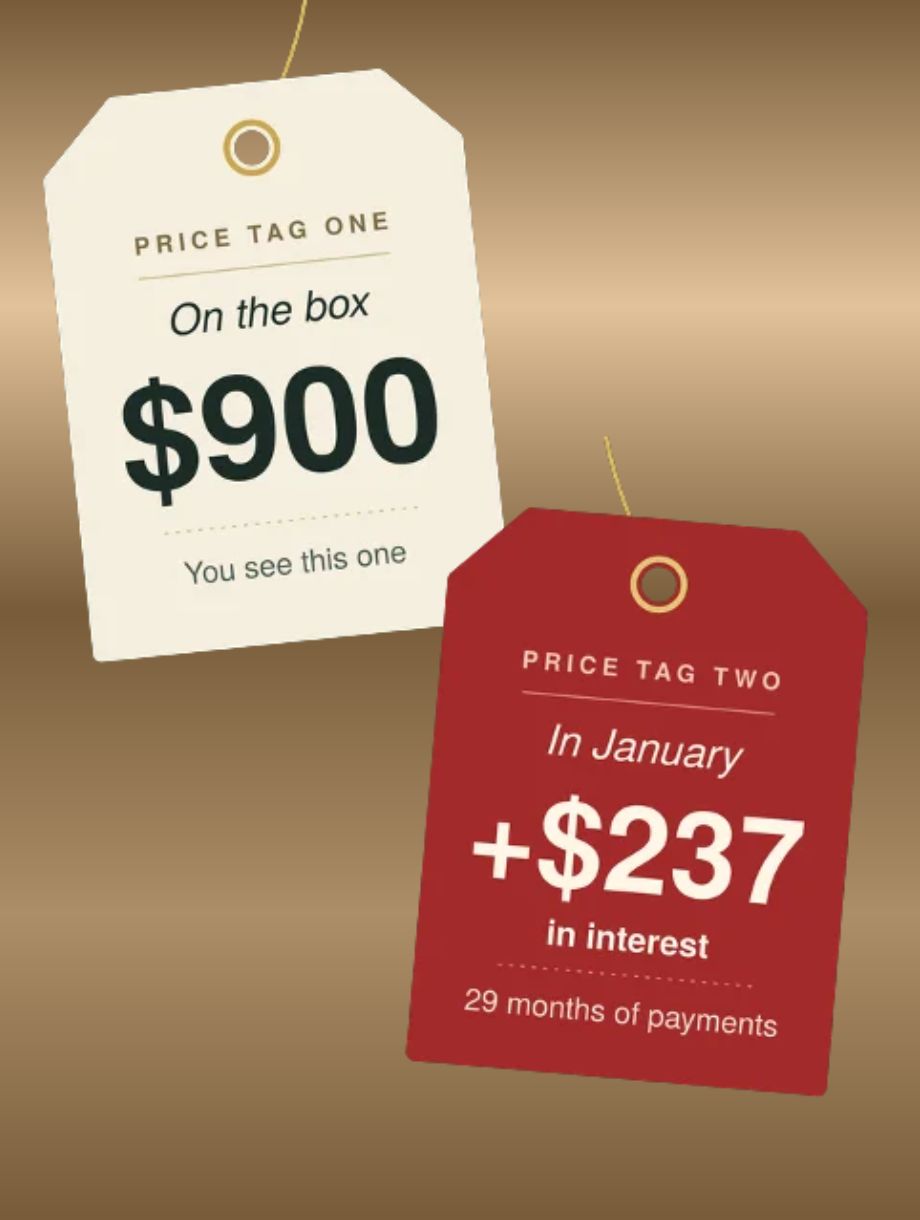
Every gift has two price tags. The first one is on the box. The second one arrives in January, and it comes with interest.
Black Friday is two days away. Before you line up, log on, or check out, ask yourself one question: Who is paying for this holiday? You in December or you for the next three years?
On November 24, a consumer research firm called The Consumer Collective released a survey of 500 U.S. adults about how they plan to pay for the season. The answers should stop every family in its tracks.
71% say they are cutting other spending to afford the holidays. Their own clothes and personal purchases go first. For more than a third, groceries and dining out are next. 63% plan to use credit cards, buy now, pay later (BNPL) plans, or both. Among people already carrying BNPL debt, 66% plan to use it again.
The average gift budget is about $900. Among millennial parents, it climbs to about $1,310, even as 72% of them report that their debt has grown over the past six months.
Let’s be fair about what this is. A survey measures plans, not receipts. And swiping a credit card is not the same as going into debt. Pay the statement in full, and a card is a tool. The trouble starts when the balance stays.
Here is the number that moves me most. When people ranked their spending priorities for the rest of the year, gifts came in ninth out of ten. Yet 88% plan to buy them anyway. That isn’t foolishness. That’s love. Families will give up their own comfort to protect someone else’s joy. I admire that. I just want that love to cost what the price tag says and not a penny more.
Nobody shows you the second price tag at checkout, so let’s look at it now.
The average credit card charges close to 20% interest. Put $900 of gifts on a card at 20%, pay $40 a month, and it takes 29 months to clear the balance. You will hand over about $237 in interest, and you will still be paying for this December when the next two Decembers arrive.
At the millennial-parent budget of $1,310, with payments of $50 a month, it takes 35 months and about $426 in interest. Nearly three years of payments for one morning of unwrapping.
Buy now, pay later deserves the same scrutiny. Four small payments sound painless, and many plans charge no interest when you pay on time. But four payments stacked on four more is how a January paycheck gets spent before it is earned.
Here is a tool that fits in your pocket: the Rule of 72. Divide 72 by an interest rate (expressed as a percentage), and you get the approximate number of years it takes money to double. At 20%, a balance with no payments doubles in about 3.6 years. That is compound interest working against you.
Now turn it around. At a hypothetical 8% return, money doubles about every nine years. For a 30-year-old, $900 becomes $1,800 at 39, $3,600 at 48, $7,200 at 57, and $14,400 at 66. Same math. Opposite direction. Interest is something you either pay or earn, and the choice gets made in moments exactly like this Friday.
1. Set your number before the sale sets it for you. Write down one total and a name-by-name list. A deal on something that isn’t on your list is not savings. It is spending with better marketing.
2. Use the one-statement test. If you can’t pay it off when the first statement arrives, it costs more than the tag says. Add up the BNPL payments you already owe before you agree to a new one.
3. Start next December’s fund this January. Divide your holiday budget by twelve. $900 is $75 a month. $1,310 is about $110. Set up an automatic transfer into a separate account and name it for the holidays. Next year, the gifts arrive already paid for.
Then run your own numbers. The Common Sense Calculator at howmoneyworks.com/calculator will show you in seconds what your money can become when time and compounding are on your side.
An old proverb says, “The borrower is servant to the lender.” It was true three thousand years ago. It is true at checkout this Friday.
Most of us were never taught any of this. No class covered it, and no one sat us down. That is why financial literacy isn’t a luxury. It is the foundation every other good decision is built on. Families don’t need more financial information. They need financial understanding.
Years from now, your children won’t remember most of what was under the tree. They will remember what home felt like. They will remember whether money was a source of tension in the house or a source of calm.
So give generously, and give within your means. The greatest gift you can give your family isn’t something you have to finance. It’s a future where money is a source of security instead of stress.
Let December pay for December. Let your future belong to you.
Tom Mathews, CFEd®
Examples are hypothetical and for educational purposes only. Payoff examples assume a fixed 20% APR with no new purchases or fees. Growth examples assume a hypothetical 8% annual return compounded annually; they do not represent any specific product or investment, and actual results will vary. Survey data: The Consumer Collective, “Give and Take: The State of Holiday Shopping in America 2026,” 500 U.S. adults surveyed November 2026. Average credit card rate: Bankrate, November 2026.